
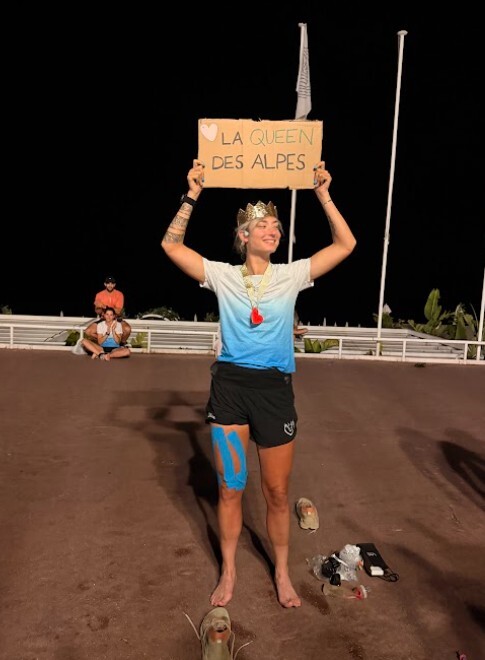
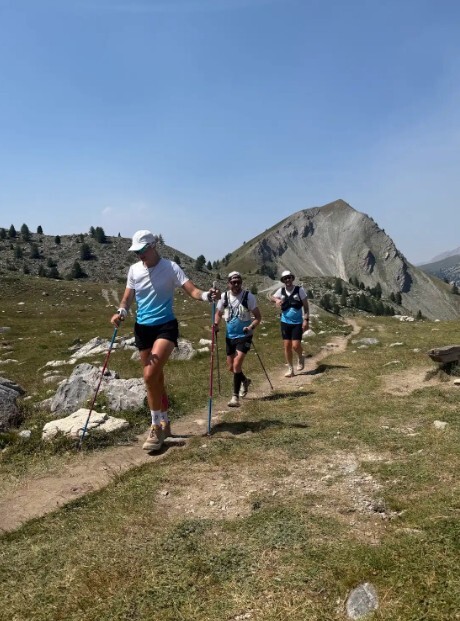
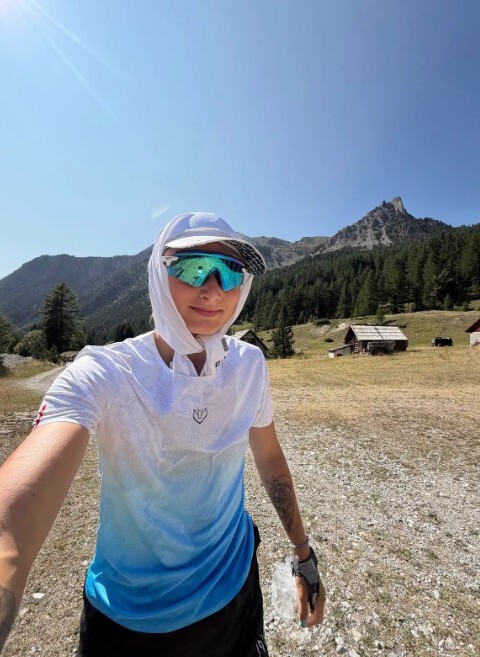
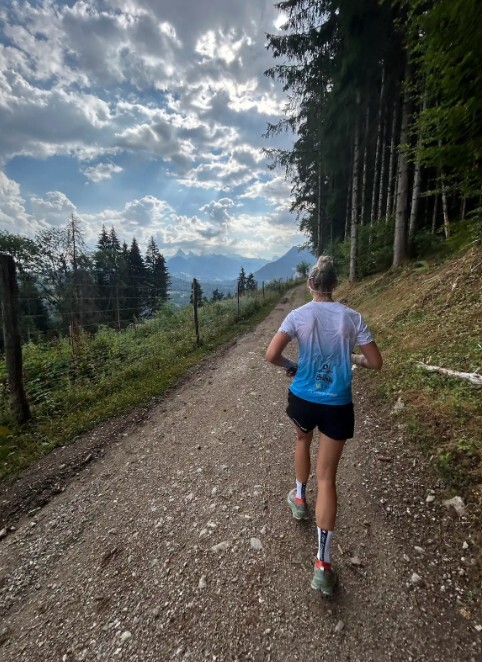
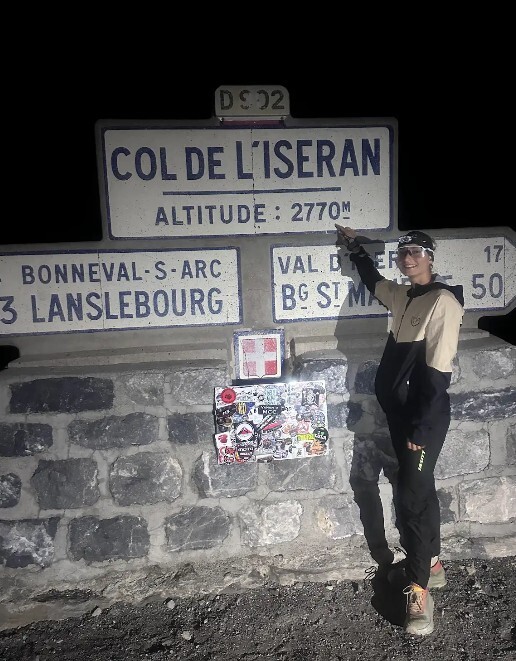
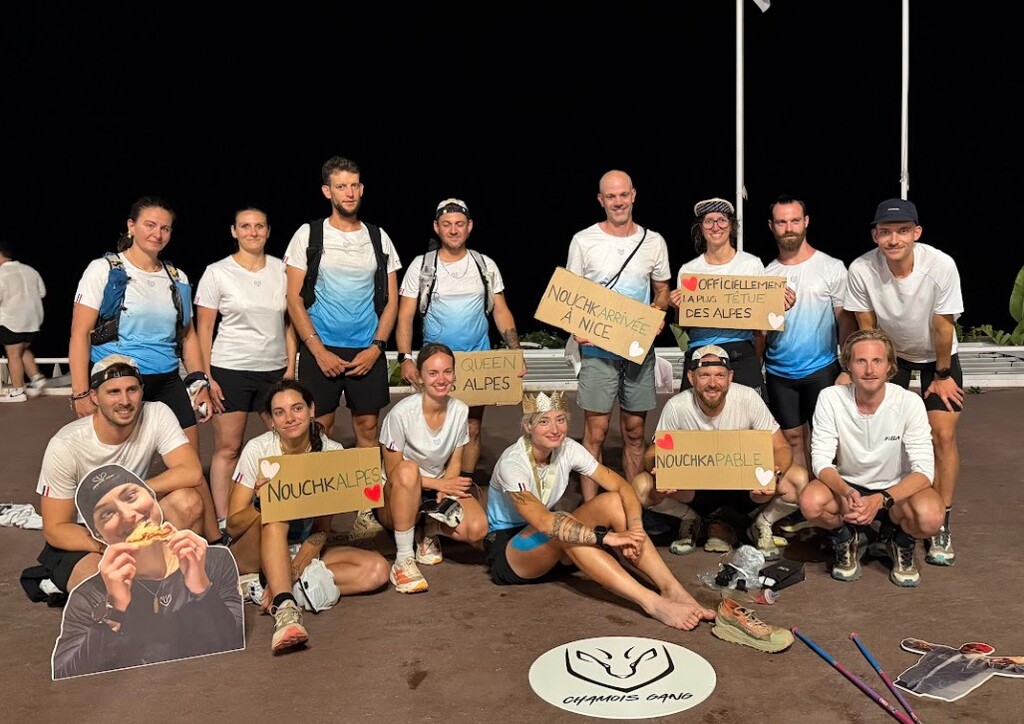
Il y a des aventures qui marquent. Cette Grande Traversée des Alpes via le GR5 en fait partie. Que dire pour expliquer ce que j'ai vécu ?
Commençons par les paysages : cette traversée est si belle. Courir à travers chaque massif fut incroyable. Chaque jour, les paysages changeaient au moins 2 fois. Le Chablais, le massif du Mont Blanc, le Beaufortain, la Vanoise, la Maurienne, les Hautes Alpes, le Queyras, le Mercantour, l'arrière pays niçois... Je garde de chaque massif des souvenirs précieux au fond de ma tête et de mon cœur.
Le défi en lui-même : une moyenne de 80/90 km et 4500/5000m D+ par jour, pendant un peu plus de 7 jours. Un défi que je n'avais jamais relevé auparavant. Les journées ont été longues sur les sentiers, les nuits courtes. Concernant les nuits, il était prévu environ 4-5h de sommeil par 24h. J'étais plus proche des 2 à 3h... Des douleurs nerveuses aux pieds puis aux jambes ont rapidement altérer mon sommeil.
J'ai fini l'aventure avec une dette de sommeil importante. Pour être certaine de rallier Nice, et espérer le record, j'ai dû faire une dernière étape de près de 160 km sans dormir, avec seulement une sieste de 20' et quelques siestes de 5' sur les sentiers. Je m'endormais en 3 secondes tant la fatigue était importante.
Et puis, l'aventure en elle-même : j'ai partagé celle-ci avec mes amis. Venus me pacer, m'encourager, et vivre ces émotions si intenses avec moi. L'aventure n'aurait jamais été aussi belle sans eux. Finalement, cette histoire est collective.
J'ai rencontré des inconnus devenus des amis, et mes amis sont devenus une famille. Ce que nous avons partagé ensemble sur les sentiers cette semaine est unique.
Pour finir, et parce que ce défi était pour moi une boucle à boucler dans mon développement personnel, je dirais qu'au-delà de trouver des réponses à certaines des plus grandes questions de ma vie, je n'ai pas seulement fermé une boucle, j'en ai ouvert de nouvelles. Je rentre en ayant trouvé, sur les sentiers et auprès des gens que j'aime, un peu plus qui j'étais.
Cette traversée à été l'aventure la plus difficile, la plus fatigante, mais la plus belle que j'ai vécu.
J'ai eu tellement mal, pendant des dizaines d'heures. Mais je n'en retiens que le bonheur de ce que m'ont offert les Alpes et l'explosion d'émotions en arrivant à Nice.
Ah, et parfois, on a l'impression que tout est écrit pour que ça se passe bien... Des petits signes de la vie qui m'ont suivi tout au long de la semaine : des papillons par dizaine qui se pose sur mes bras, des aigles (emblème de Nice) qui tournent juste au dessus de ma tête à l'entrée du département 06, des patous restés "gentils" dans des zones où ils sont réputés agressifs et où je suis passée de nuit (c'était pas rigolo), et le gros orage prévu à Nice pour mon arrivée qui finalement ne m'aura jamais touché : il a tourné tout autour de moi sans jamais être sur moi, me laissant la voie libre pour aller concrétiser cette grande aventure.
Merci les Alpes. Pour ce qu'elles m'ont offert, et ce qu'elles vont me permettre d'écrire ensuite.
Comments
At that point, it no longer resembles traditional trail running as many people understand it, but rather a highly supported endurance project designed in part for social media and public visibility.
It is also worth noting that, based on her publicly available race results, she has generally recorded respectable but not exceptional performances in trail running. To my knowledge, she is not considered an elite athlete, nor is she particularly experienced in very long-distance or multi-day events. Her publicly shared photos and videos also appear to show that she is consistently accompanied by several members of her support team during her projects, including on shorter trail runs.
Taken together, these elements naturally raise questions, particularly considering that, according to the content shared during the attempt, she appeared to be struggling significantly and running behind schedule after only two days. We may never know the full picture, but this FKT leaves me puzzled. Moving from otherwise ordinary trail and ultratrail performances to an FKT is, at the very least, something that invites closer examination.
Another point that caught my attention concerns her Strava data. As she approached the end of the route, she appears to have achieved personal bests or segment records on several sections. In other words, despite having accumulated nearly a week of continuous effort, her pace seems to have improved on certain segments. Given the physical demands of such an undertaking—and assuming the tracking data accurately reflects the effort—this may appear counterintuitive. How could someone who reportedly seemed exhausted after only two days still be setting segment records several days later? I cannot explain it, and it seems difficult to reconcile with what was publicly documented during the attempt.
Finally, there are several unusually straight sections visible on the OpenRunner track. I have no evidence that these indicate any irregularity, and there may be entirely legitimate explanations, including GPS signal loss or tracking artefacts. However, they do raise questions. One possible hypothesis—among others—would be that the GPS device stopped recording for part of the route, although I have no evidence that this occurred. Without independent verification, it would not be appropriate to draw any conclusion from the tracking data alone...
The previous comment likely stems from an idea popularized by U Trail, a French social network known more for spreading baseless gossip than reliable news. irrelevant.
Ah, that famous comment posted at 5:50 a.m.... There are two possibilities: either you were already up to go for a run, or you woke up with a divine mission to act as an investigator for the FKT Bureau. I have my suspicions.
So let’s summarize the case:
“She had a support team.” Yes. That’s precisely the concept behind a supported FKT. The rules have always allowed for logistical support as well as pacers. This isn’t some new rule invented for Nouchka. In fact, when François D’Haene set his GR20 record, he too was accompanied by pacers and received support. No one discovered that day that the “supported” format even existed.
“She wasn’t carrying any water or food.” Again… yes. That’s precisely the point of a supported attempt: to optimize the journey between aid stations. If you want to carry everything you need, then it’s called a self-supported or unsupported FKT.
“She wasn’t a trail running star.” So what? FKTs aren’t a world championship reserved for the UTMB elite...
The most amusing part is the method of analysis:
“I looked at his Instagram photos.”
“I checked Strava.”
“I found some straight lines on OpenRunner.”
Conclusion: the launch of an investigation worthy of *CSI*.
As for the straight lines on an OpenRunner GPS track, they’re usually explained by cell phone signal loss. Using them as incriminating evidence without proof is a bit like concluding that a UFO landed just because a photo is blurry.
Ultimately, the entire commentary rests on a fairly simple line of reasoning:
“I can’t wrap my head around this performance, so it must be suspicious.”
Fortunately, that’s not how proof works. Skepticism is healthy, but we need facts—not an essay based on Strava, OpenRunner, and a few Instagram screenshots...
In short, if a record is to be called into question, let’s do it with evidence. In the meantime, discovering at 5:50 a.m. that the “supported” format allows for a support team might just be the real record of the day.