



Hjälmaren runt
This was my third attempt at the lake. The first was a supported run in February where temperatures dropped to -13°C. I stopped with Johan at Husby-Rekarne kyrka at 88 km that time. The second attempt was in good weather in early April, but I only managed 102 km and hitchhiked back to Örebro. I was starting to lose my confidence! Third time lucky, I hoped.
I ate some porridge with syrup on the way over, along with a cup of coffee when I stopped to park, and a protein drink and a little bit of water. I arrived in Örebro just before 00:30 on Tuesday, 3rd June intending to set off shortly after this time. Parking in zone 1 in Örebro becomes expensive in summer, so I made a last-minute switch to a side street in zone 2 — only two extra minutes' walk from the castle compared to the Hamngatan car park I used last time, but well worth it as it saved me over 200 SEK in fees. This added a bit of time for me to actually find some different parking.
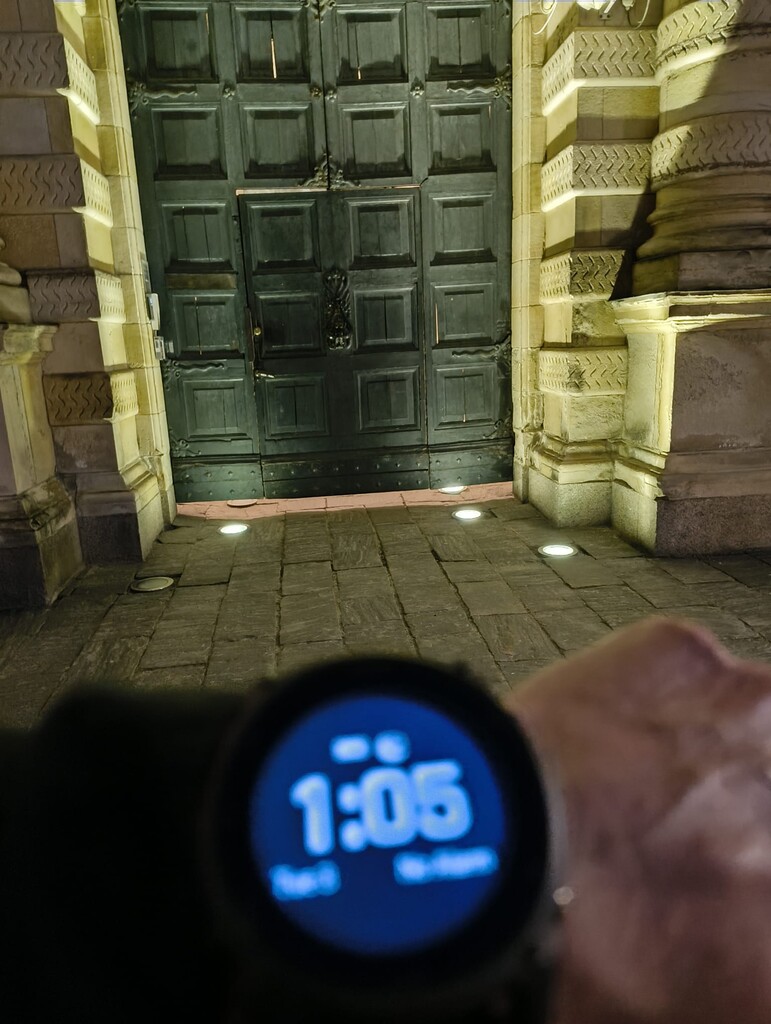
I set off from the castle at 01:05 with the booming noise of the local nightclub ringing out.
I started at around 6:30 min/km pace, aiming for closer to 7 min/km. The trip out of Örebro was a pleasant one — guided through the town streets by my Garmin watch, which began the run at about 98% battery.
As I headed east toward Arboga, the first light of dawn followed me along the horizon, a faint glow stretching beneath a dark sky. The early part of the route was a mixture of tracks, pavements, and smaller roads - easy to run on and easy to navigate. After about 25 km, the route was mainly on roads, but large verges meant I wasn’t too close to passing vehicles, and most gave plenty of space.
I was fuelling with Tailwind solution and 4Energy performance gels. I decided to walk the first uphill out of Arboga while sipping a protein shake just to give the legs and body a little rest. This first 40 km to Arboga went well, though strangely my legs started to feel a little tired arriving in town.
At about 50 km, I stopped for a toilet break in the woods and noticed that my carbs weren’t digesting well. I continued with Tailwind and gels until I reached the ICA in Alberga at 65 km, my first planned rest stop. From 50 km to 65 km I mostly power-hiked.
At ICA, I refilled my 2L bladder and two 500 ml flasks with water — I skipped adding Tailwind, hoping to settle my stomach. I wasn’t sure whether it was the Tailwind or gels and for a while I decided to have neither but if I was going to keep pushing forward I knew I needed to have some energy coming into me. I also had a 500 ml Coke and another protein shake at the ICA. After 25 minutes of lying on the ground with my legs elevated, I was ready to continue. I left town slowly, detouring into the woods for another toilet stop.
Due to having to walk I changed my plans and I aimed to reach Husby-Rekarne kyrka (around 88 km — roughly halfway) by 15:00, which meant targeting 10 min/km pace. Initially, I didn’t think I had the energy to run, but I tried a run/walk strategy, averaging about 9 min/km, but as I thought I wouldn’t be able to sue the majority of my carbs I had brought I made sure not to over commit myself even if I could run.
Coming into the churchyard, I was exhausted — both physically and mentally. The run/walk strategy had gone well but my tummy was feeling upset again and I had to power-hike the remaining 6 km to the church. I had no idea what time it was. I lay on the grass under a large tree while church staff went about mowing the lawn and other work. Legs elevated, hot, sweaty, drained — I just wanted it to be over. I seriously thought about giving up at this point. I really needed to dig deep to think about my purpose and why I was undertaking the challenge.
After about half an hour, someone approached and asked if I was okay. I told them I was resting and asked for the toilet. I took a caffeine gel before going to the toilet where I cleaned my face — when I came out, another staff member wished me luck. I felt almost like a new person.
I set off again at about 9 min/km pace, calculating that if I could maintain around 10 min/km on average, I would reach the next ICA in Äsköping by 20:00 — one hour before closing. Missing this would have made it difficult to resupply water and snacks and probably would have put a stop to my challenge.
The next 30 km were tough on the legs — a pure power hike. The landscape was beautiful, woods with scattered fields and the trees glowing in the soft light of late afternoon. It was pretty warm and I made sure to drink all my liquids and I started taking my gels again on this leg. Around 18:00, as traffic eased, I sensed the day winding down.
I used my new Truefree earphones to listen to music while still being able to hear approaching traffic — great for motivation and safety, though they drained my phone battery faster than expected.
I reached ICA around 20:00 and refilled water, grabbed a protein drink, patched some blisters with plasters, and once again lay with my legs up. I chatted briefly with a lonely woman at the next table before setting off around 21:00 — just 60 km left. How hard could it be? The last stretch...
My initial plan was to finish around 22:00 the same day (so an hour later than I left ICA) and sleep in the car in Örebro for a few hours before heading home. Now, due to my pace being slower, this would be a second full night with no sleep. I’d tried napping at the church and ICA, but couldn’t drift off. There were no safe places to sleep along the roadside either.
Around 22:00, my phone battery died — so my live tracker stopped working — but thankfully my watch was still recording the run.
Leaving Äsköping, I ran into swarms of flies buzzing into my face and hair — incredibly annoying, though it only lasted about 30 minutes.
The sunset that evening was stunning — a deep blood-red ball sinking below the horizon ever so slowly. I wished I could have captured it.
After dark, I followed road 214, which was tree-lined and dim but passable without a headlamp. I used my headlamp sparingly, conserving its battery and turning it on only when cars approached.
Blisters on my feet caused the most pain by this point. My legs were sore but manageable; the blisters felt like the biggest threat to finishing. Still, there was only one way out: forward. I stopped a couple of times to readjust or put new plasters on. However I realised a gel had leaked and had soaked most of my plasters. Soul destroying.
It grew cold during the night — around 7°C, though it felt colder. By 02:00, I was tired and shivering and would have given anything to lie down for 30 minutes, but there was nowhere safe to do so.
Mentally, I broke the final 60 km into three 20 km segments. I expected to hit road 52 after 20 km (although I know it was after around 19km), then turn toward Stora Mellösa away from the 52 which would have meant there was around 20 km remaining.
Road 52 was mostly fine at night. If you time it for a quiet period (as I accidentally did), you can avoid traffic. In some spots, the verge was narrow — potentially risky if traffic had been heavier.
A few passing cars cheered me on in Swedish, which was a welcome boost.
When I saw the sign for Stora Mellösa, I was relieved — only about 25 km left. But the distance felt endless; every kilometre seemed to tick by agonizingly slowly.
Strangely, during this last section I felt as though family members were with me, encouraging me and offering advice. I was craving sleep badly, and I’m sure 30 minutes would have helped enormously.
Passing through Stora Mellösa, the winding road seemed to go on forever. I hadn’t studied this final stretch in detail recently (lesson learned), so I wasn’t sure how long it would last before getting into Örebro.
As I neared Örebro, commuters started appearing around 05:00–06:00. Traffic increased, though the lane with traffic toward me remained quiet which was great for not having to move aside too often. I kept my head down and pushed on. Rain began to fall, but by then it was warmer, and the rain didn’t bother me.
Reaching the cycle path before Örebro was a moment of joy — I had dreamt of this part of the route. The simple pleasure of switching from road to path felt monumental to my sleep-deprived brain!
But there was still about 5 km left — one more hour of power walking. The rain seemed to die away around this time too.
I followed my watch navigation through Örebro. Commuters and schoolchildren must have found the sight of me, staggering toward the castle at 08:00, quite strange — I must have looked like a zombie.
Finally, I reached the castle, touched the door, and stopped my watch: 38% battery remaining.
32 hours, 9 minutes and 40 seconds, two sunrises, and one sunset after I had started. I gave myself a little smile - but no selfies, no photos.
I hurried back to my car, charged my phone, texted my wife that I was safe, and finally went to sleep.
I won’t attempt Hjälmaren again — three tries was enough! But it is runnable, especially if you’re supported. With good planning, my time should be easily beatable.
If anyone is considering an attempt, feel free to reach out — I would love to see my record broken and hear about your story!