


Pacific to Summit: Mt. Adams
I live a relatively ordinary life—but every so often I feel the pull to do something a little unreasonable. Something difficult. Something human-powered. Something just far enough off the beaten path that it leaves me hungry for more.
This summer that pull led me to connect the Pacific Ocean to the summit of Mt. Adams entirely under my own power. To the best of my knowledge, this is the first documented human-powered Sea to Summit of Mt. Adams. If anyone knows otherwise, I'd genuinely love to hear about it.
Two years ago I completed my first Sea to Summit of Mt. Rainier and absolutely loved it. There's something magical about watching a mountain slowly emerge from the darkness, knowing you're going to stand on its summit using nothing but your own body. It feels almost impossible—which is probably why it's so enticing.
Last summer I completed a Sea to Summit of Mt. Baker.
This year I wanted another Washington volcano. St. Helens permits were gone, Hood's season had ended, Glacier Peak wasn't quite the right objective yet (though it's firmly on the list), so Mt. Adams became the obvious choice.
Although I enjoy solo adventures, I wanted this one to be different.
I've learned that the bigger the objective, the less it becomes about doing it alone. Company makes long days richer, and support makes big objectives safer.
The team started coming together long before we ever reached the coast.
For the cycling portion I immediately thought of Mick Walsh. Anyone who knows Mick knows how understated he is despite being one of the strongest endurance cyclists I've ever met. He has ridden over 410 miles in a 24-hour race, completed Paris–Brest–Paris, finished countless 1,200 km brevets, ridden Seattle to San Francisco in four days, and was Washington State Elite Road Race Champion.
To my delight, he was in.
Even better, his amazing wife Martha volunteered to drive support. I hadn't planned on a support vehicle, but it became one of the greatest gifts of the entire adventure. Their experience, encouragement, and kindness made the day not only more successful, but infinitely more enjoyable. Plus, a solo cup of Coke at mile 140 was exactly what I needed.
Behind the scenes, Colton quietly spent roughly 22 hours getting both of my bikes ready. Fresh sealant, new cables, new bar tape, careful adjustments, and countless little details I never would have thought about. When equipment works perfectly, it's easy to forget someone invested an incredible amount of time making sure it would. His work let me focus entirely on the adventure.
For the climb, I hoped to rally my friend Shane Robinson—a phenomenal mountain guide and ski mountaineer. Shane is everything you want in the mountains: strong, calm, knowledgeable, and steady. Somehow he happened to have the weekend free.
By my own standards, I was undertrained.
I hadn't ridden over 100 miles in more than a year. I'd never climbed after biking. Most of my "training" and taper consisted of biking to work, squeezing in whatever I could, and hanging out with my kids.
But I had a feeling.
If I stayed mentally steady, surrounded myself with good people, stayed on top of nutrition, and simply kept moving, maybe I could string together a good day.
There was only one way to find out.
Friday I finished clinic, rode home, met Mick and Martha, loaded four bikes into the Jeep, battled endless I-5 traffic to Astoria, grabbed Mexican food, slept at the Motel 6, and woke at 5:30 a.m. for instant coffee and Martha's amazing steel-cut oats.
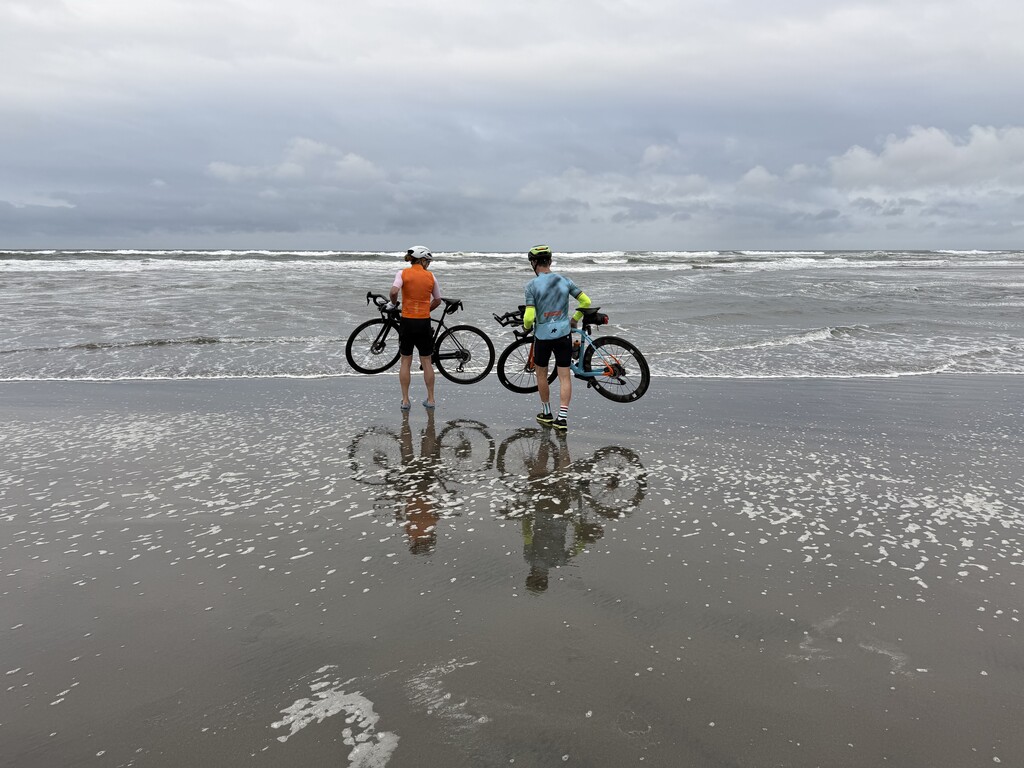
We chose to begin at the wreck of the Peter Iredale.
There was something poetic about starting beside a shipwreck—a reminder that even enormous vessels can be humbled by the sea—before setting off on our own human-powered journey from the Pacific Ocean to the summit of Mt. Adams.
We dipped our wheels into the Pacific, brushed the sand from our feet, and rolled away.
Mentally, I kept reducing the day into smaller pieces.
First goal: make it 50 miles. I've done that plenty of times.
Drink both bottles of Tailwind before seeing Martha. Easy.
Consume roughly 900 calories in the first three hours. Also doable—just a sip or bite every fifteen minutes.
I'd packed candy thinking it would be a treat, but nerves completely changed my appetite. For almost the entire 26 hours I lived on Tailwind, SIS Beta Fuel, Maurten, Invictus gels, and a steady stream of carbohydrate drink mix. Real food sounded terrible. I finally forced down half a sandwich somewhere around mile 170, but I had no real interest in "real food."
Bit by bit we crossed Oregon and Washington on spectacular roads.
Mostly I stayed tucked behind Mick's wheel, stayed relaxed, and resisted the urge to push harder than necessary.
Before I knew it we'd covered nearly 180 miles, I'd consumed roughly 4,000 calories, and it was time to switch to gravel bikes. Mick peeled off to support from the car while cheering me on.
The final climb to the South Climb trailhead gains nearly 4,000 vertical feet in just nine miles.
It turned out to be one of my favorite parts of the ride.
The light faded, the forest went quiet, Jeep headlights supplemented my bike light, and my Garmin slowly counted down each remaining thousand feet. Instead of wishing it were over, I found myself wishing the climb would last a little longer.
Fourteen and a half hours after leaving the Pacific Ocean, I rolled into the trailhead.
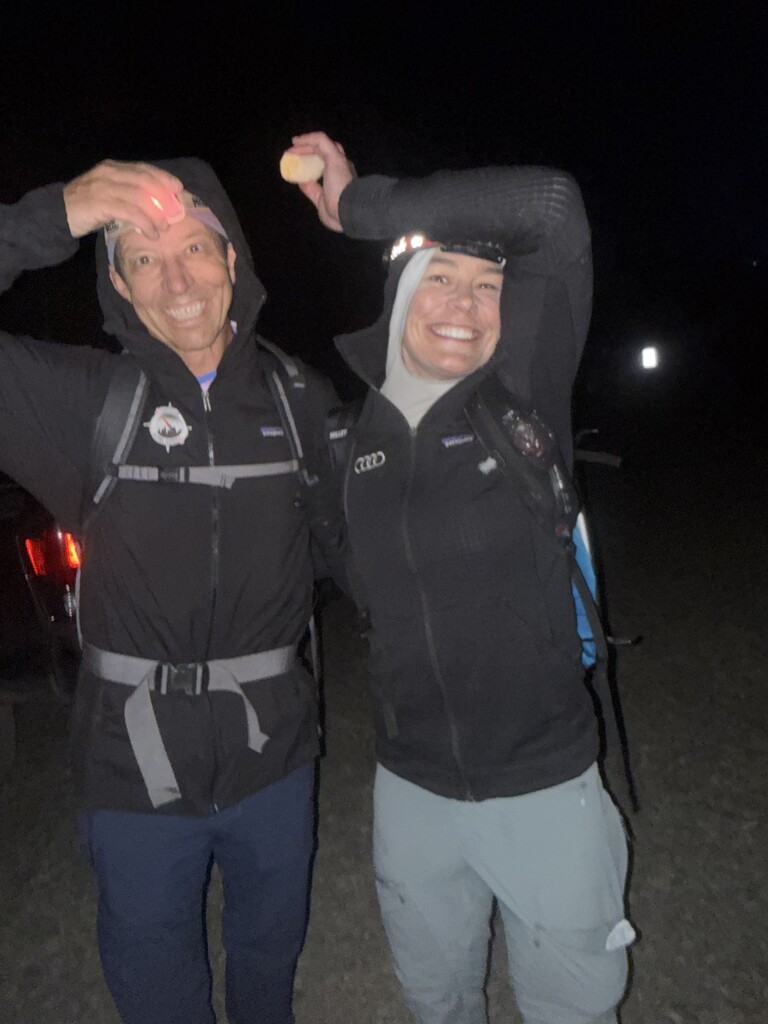
Shane was waiting with my climbing gear.
After thirty minutes of changing clothes and staring blankly at food while trying to decide what sounded remotely edible, we stepped onto the trail at 10 p.m.
Normally uphill hiking is my happy place.
This time it wasn't.
Within about forty minutes I realized something simply didn't feel right.
I slowed down, ate, drank, pressure-breathed, and kept trying to stay present.
Around 8,000 feet, the sleep deprivation hit harder than anything I'd ever experienced.
The snow seemed to move beneath my feet.
I'd briefly lose focus and nearly miss steps.
At one point I became convinced I was walking across moss-covered rocks beneath a shallow river instead of snow.
I wondered if I was safe to continue.
Instead I blinked, pressure-breathed, took another sip of water, another bite of sugar, and kept moving.
One small step.
Then another.
It continued nearly all the way to the summit.
Anyone who's done overnight endurance events knows those final hours before sunrise can feel impossibly long.
So I kept shrinking the mountain into smaller and smaller goals.
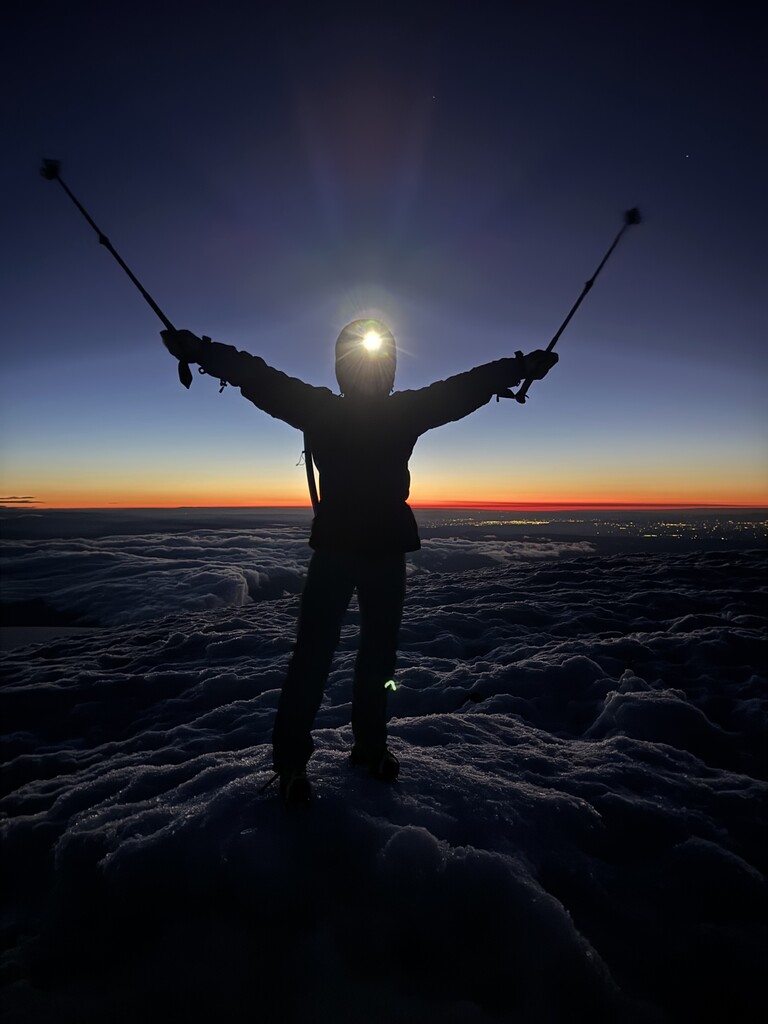
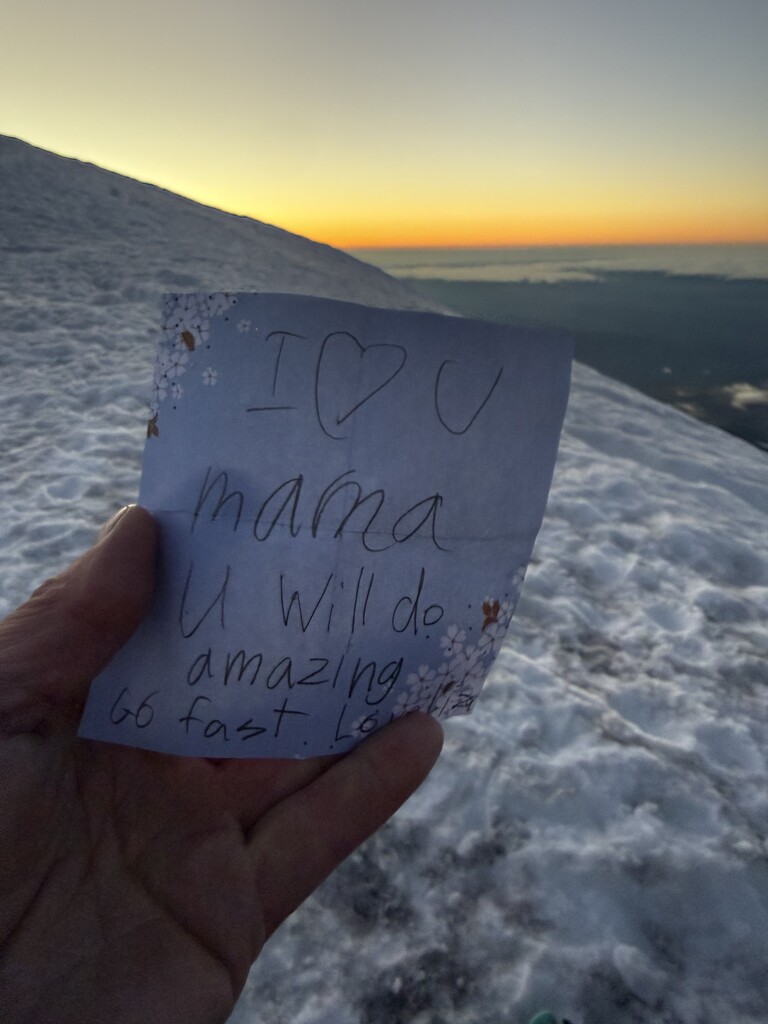
Eventually, at 4:30 a.m., we stepped onto the summit.
The winds were ferocious—steady around 40 mph with gusts well over 50. My forearms were sore the next day simply from gripping my trekking poles.
Sea to Summit—from the Pacific Ocean to the summit of Mt. Adams—took 21 hours and 25 minutes.
The descent, surprisingly, wasn't nearly as bad as I expected.
At one point we tucked behind a rock out of the wind, rested our heads against it, and both fell asleep almost instantly.
Ten minutes later we woke up.
I'd had two incredibly vivid dreams.
Realizing I was still sitting high on Mt. Adams—not back in my own bed—was one of the strangest moments of the entire weekend.
The glissade tracks were still frozen and not yet safe, so we walked every downhill step.
Eventually the blinking lights of the cars at the trailhead came into view.
A tiny part of me was sad the adventure was over.
Back at the Jeep we traded ski boots and mountaineering layers for cotton clothes and began the long drive home.
Mt. Adams always feels farther from Seattle than it should.
Most of the drive was spent talking about future ski lines, mountains, and Washington objectives—partly because those conversations are fun, and partly because they helped keep us awake.
By about 3 p.m. I finally made it home.
I unpacked almost everything.
Mick and Martha graciously drove my bikes back to Seattle, saving me another trip south. Yet another gift from the weekend.
Colton had already spent the previous week pouring more than twenty-two hours into getting both bikes ready. By the time I finally walked through the front door, I think we'd both earned Thai food, so I ordered takeout. I was honestly too tired to eat much of it.
I showered.
Slept from 5:30 p.m. until 5:30 a.m.
Woke feeling shockingly good.
Rode my normal 22-mile commute to work.
Operated all day.
And somehow felt lighter than an average Monday.
People sometimes ask why I keep doing things like this.
The honest answer is that I don't entirely know.
I like seeing what my body is capable of.
I like solving complicated logistical puzzles.
I love moving through wild places under my own power.
But I think what keeps drawing me back is something less tangible.
Adventures like this strip life down to its essentials.
Eat.
Drink.
Keep moving.
Trust your teammates.
Take the next step.
Somewhere along the way, all of the other noise disappears.
Looking back, what I'll remember most isn't the mileage or even the summit.
It'll be Mick calmly setting the pace for hundreds of miles without ever making it feel hard.
Martha somehow appearing with exactly what we needed, exactly when we needed it.
Shane quietly walking beside me through the hardest hours of the night, never rushing, never doubting.
Colton spending twenty-two hours making sure my bikes disappeared into the background so I never had to think about them once.
I don't think challenges like this make us extraordinary.
If anything, they remind us what ordinary people are capable of when they're surrounded by generous people and willing to keep taking one more step.
I'm incredibly grateful to have shared this one with all of them.
A few days before the climb I came across this quote about The Odyssey. It captured exactly why these kinds of adventures continue to draw me back.
"People are sick of sleepwalking through life. Humans are meant to exert effort and go on quests... You can say no to endless convenience and, if you're lucky, choose your hard. Meaningful struggle makes you feel alive. When you give something your all and take responsibility for it, you face the very real chance of failure and accept the outcome, whatever it may be. It introduces you to your own capacity. You don't know what you're capable of until something bigger than you tests it. Modern life optimizes the quest out of us. But facing friction, developing skill and making progress—mastery and mattering—are some of the most satisfying and humbling things there are."
— Brad Stulberg