
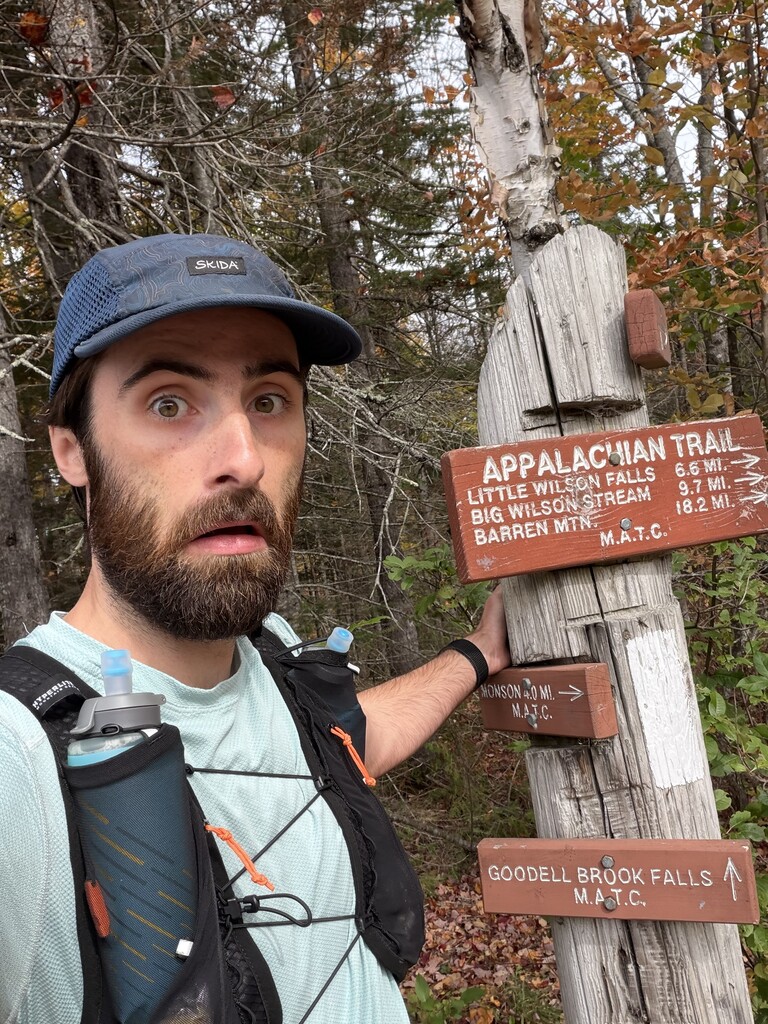
The Hundred Mile Wilderness has chewed me up and spit me out more than any other route. This was my fourth attempt at an FKT on the HMW. The first time in 2021 I ran it as a team with Xander Keiter and Nik Hase. It was the first 100 miler for all 3 of us, and we had no idea what we were in for (we came in at around 34 hours.) The next two tries (I believe in 2024 and 2025) I got derailed by nausea/vomiting.
Going for this was a last-minute pivot. I planned a supported attempt at the New Hampshire Appalachian Trail FKT (and had awesome crew/pacers lined up), but as the day got closer, the higher summit forecast showed high winds, freezing temps, ice accumulation down to 4,000 feet, and limited visibility up high. I was supposed to start on 10/8 and ended up calling off the attempt on 10/7. I figured that the HMW was an obvious pivot since it has zero terrain over 4,000 feet and very minimal exposure.
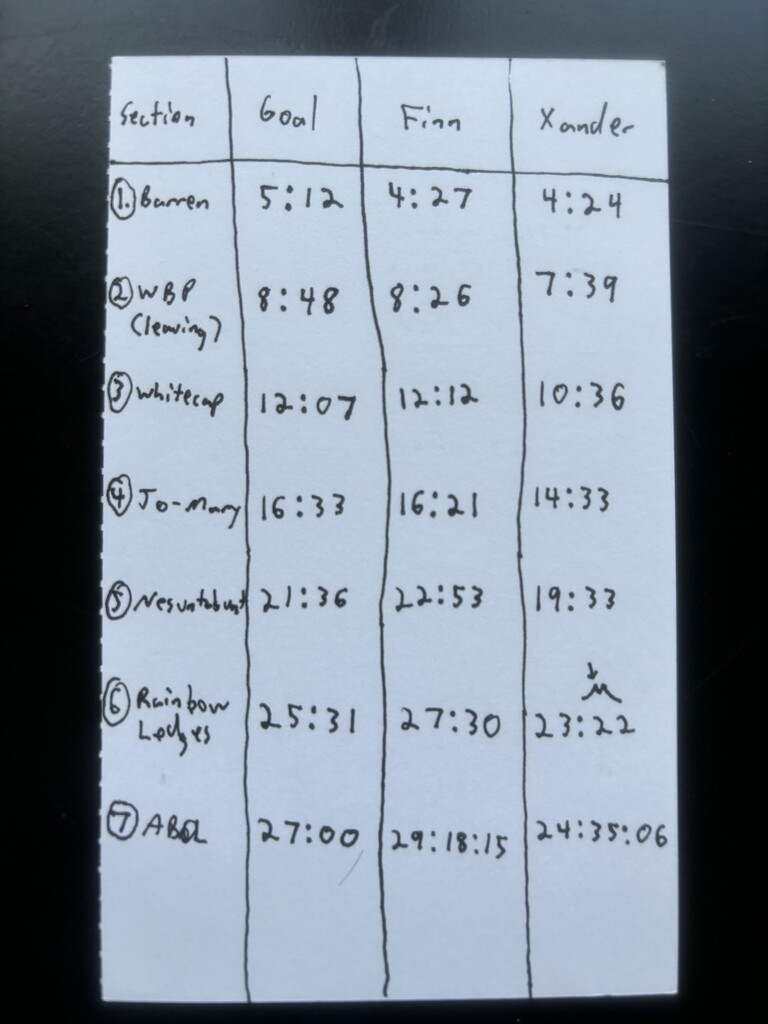
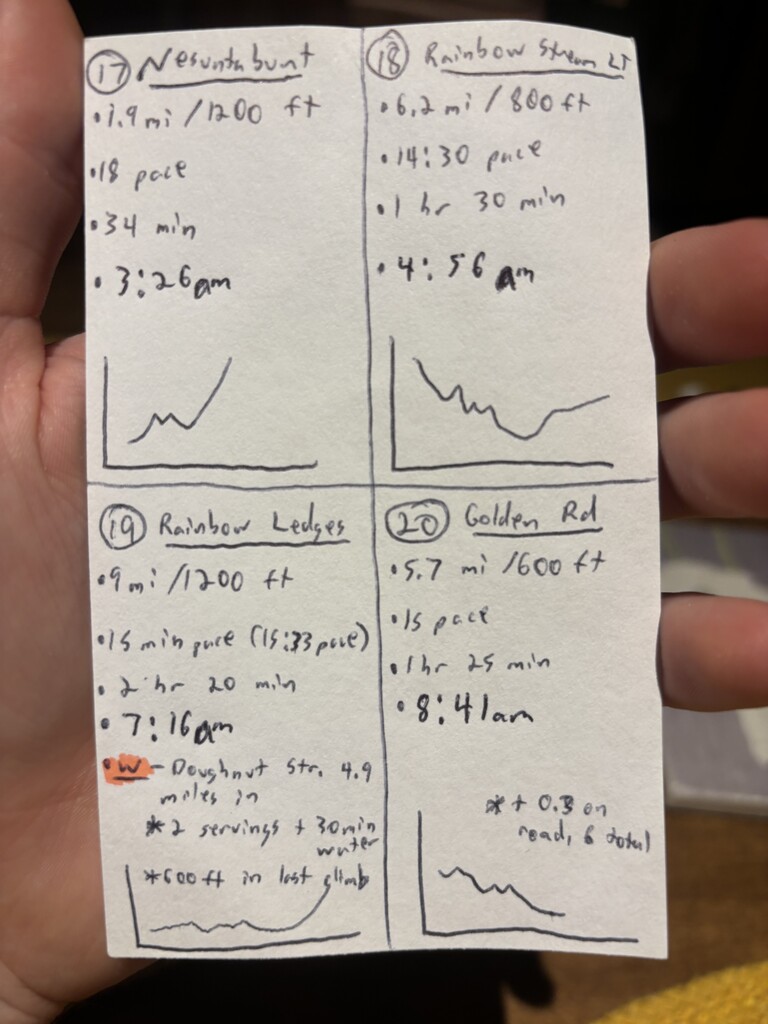
I only had about 48 hours to get ready and get to the start line, but fortunately I already had a plan to work off. The last plan I made for the HMW in 2025 had a goal time of 27 hours. This was before Austin set his FKT and before Xander set his sub-24 hour time, which is why my split goal card below shows Finn’s splits and Xander’s 2023 splits. I also already had all my gear and nutrition organized for the NH AT, so it didn’t take much to get everything re-organized for the HMW.
I started at noon on Friday 10/9. The thought process was to take the night hours earlier and during more of the hiking terrain because I think there is more of a pace penalty for night running than for night hiking. The split cards I made in 2025 had a start time of 6:00am (I attached one for reference), so I just had to add 6 hours to all the ETAs.
Section 1: Start to Long Pond Stream Lean-to – The first section went smooth. I knew that if I tried to go out as fast as Austin, I would probably blow up, so I took it easy and hoped to make up time on the back end. The first thing I noticed was that the time of year accentuated the different types of forest. The deciduous dominated areas were in peak foliage, and fallen leaves made the footing just a little bit tricker than usual, while the pine dominated areas looked and felt basically the same as always. Big Wilson Stream was surprisingly high given the overall low water levels, and I had to ford it. I know there is a dam somewhere upstream that can fluctuate the water levels, so perhaps that dam was open. Big Wilson and the West Branch Pleasant River were my only mandatory fords of the run.
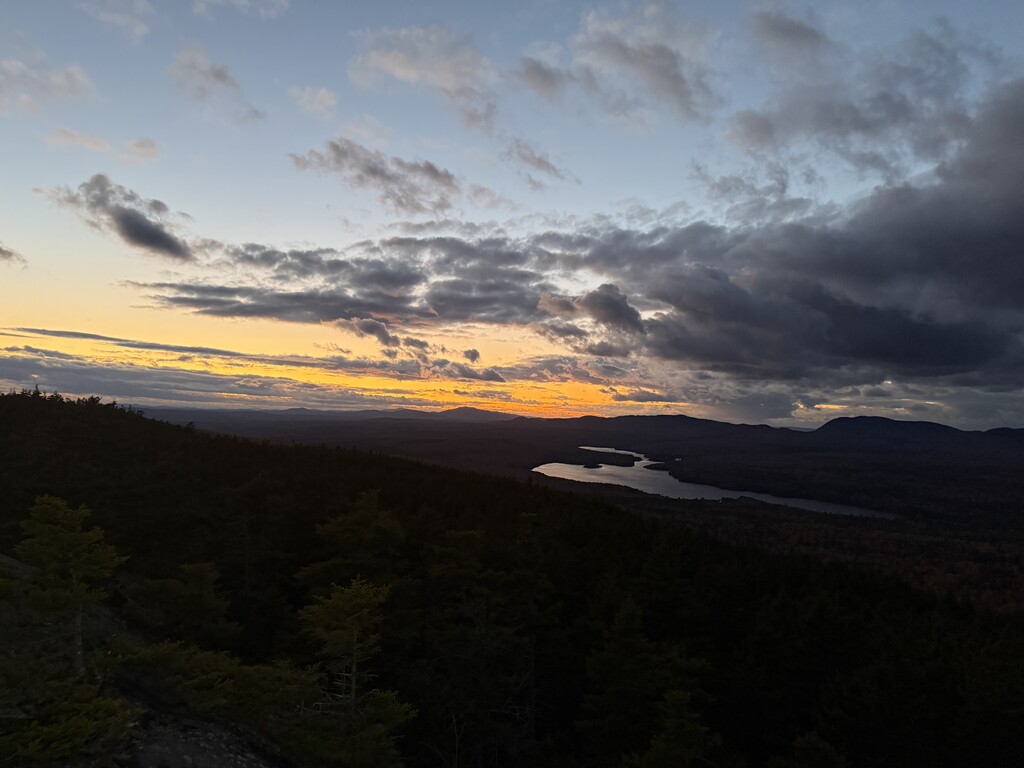
Section 2: Long Pond Stream Lean-to to West Branch Pleasant River – The Chairbacks are always a fun time. I lost daylight somewhere along the ridgeline and got a fantastic sunset on the exposed ledges (see photo below). Not a ton else to say about this section, I felt like I paced it evenly and was able to make pretty good time.
Section 3: West Branch Pleasant River to East Branch Lean-to – I decided early on that I was going to try to minimize stoppage time. The big things I had to contend with in this regard was mixing nutrition and what to do with the fords. For the two fords I decided to just send it and deal with the wet feet. I believe my total stoppage time was <20 minutes. After blasting through the West Branch of the Pleasant, I headed up Whitecap. My climbing was fine, not great and not terrible, and I hit the summit just before midnight. The 3650-foot summit was cold. It had some rime ice and the wind was howling, which made me feel better about my decision to bail on the NH AT. When I started descending Whitecap, I saw that my Petzl Nao RL headlamp was saying that it was almost dead. I don’t know if the battery god cold on Whitecap and made it freak out, but I turned it to a dimmer setting and continued to use it for the next 6 hours without issue.
Section 4: East Branch Lean-to to Antlers Campsite – The next section is when hammer time generally starts. I think this can be a bit of a trap because it’s so runnable, but you still have 60+ miles to go. I think it can goad people into running too hard, which is likely part of why few have been able to run the last 30 miles well. I knew I needed to take advantage of these miles, but I intentionally tried to keep it smooth and controlled, and I hoped that doing so would allow me to run well when the sun rose in the next section. As an aside, right after Johnson Pond Road I got turned around and took an incorrect side trail to the beach, which probably cost me a couple of minutes.
Section 5: Antlers Campsite to Nesuntabunt – The sun came up between Potaywadjo Lean-to and Nahmakanta Stream Lean-to. It was a beautiful morning, and right after the sun started rising, I saw a bright gold fox, which was my only real wildlife encounter of the run. This section of trail has some surprisingly technical bits, especially when compared to the highly runnable terrain of the last section. I think this can lull you into walking sections that you should run, and I knew I needed to avoid that. To accomplish this, I made up a buddy that was “running alongside me” keeping track of what percentage of the time I was running vs hiking. I also made up that he would get upset with me whenever I hiked on a flat/down, no matter how technical it was. He didn’t care about the pace, just that I keep a running gait. This was surprisingly effective, and I was able to mostly run the flats/downs on the back end. Was I going a little nuts seeing almost no one out there? Perhaps. Perhaps not. Also, Xander and Finn hammered the death trap of Nesuntabunt into me so much that I was ready for it, and it didn’t feel like too big of a deal when I got there.
Section 6: Nesuntabunt to Abol Bridge – Xander likes to describe this last section as “purgatory”. The 9 miles between Pollywog and Rainbow Ledges are very beautiful but don’t have a ton going on. It is very flat and it is a mix of technical lakeside terrain and runnable terrain when the trail goes higher up off the shore of Rainbow Lake. I just continued my strategy of focusing on running the flats/downs regardless of the technicality. When I got to the occasional uphill, it was very clear that my climbing legs were completely cooked. With about 8-10 miles to go I started getting bad heartburn when eating and running. It would get worse and worse when running and then would turn into intense nausea/dry heaving. Unfortunately, this somewhat limited my ability to run those last few miles, and I probably left 10-15 minutes on the table because of it. Despite that, when I hit Rainbow Ledges and got my stunning view of Katahdin, I realized that I still might be able to sneak under 27 hours if I could just move reasonably well the last few miles. The run down from the ledges was a battle between the heartburn/nausea and my desire to be done.
I arrived at Abol Bridge to an awesome surprise—Chris Keiter (Xander’s dad) drove up to see the end of the run and to give me a ride back to my car. Chris has just as much love for the HMW as Xander and I do, and it was so nice to see him at the finish.
Shout out to Shaw’s Hiker Hostel – before Chris came up, they were going to pick me up at the end. They are some of the absolute best folks in the HMW community, and they offer great services in the HMW in terms of shuttles and supply drops. If you’re interested in running or backpacking this route but intimidated by the logistics of getting from one place to another, I’d highly recommend giving them a call and using their services.
This time of year is great for solitude. I saw six people total, five of which were in the first 20 miles, so I saw one person in the back 80. The temps were perfect (high of high 50s during the day and low of high 30s at night), other than some legit cold/wind /ice on top of Whitecap. Another big advantage of this time of year was that the bugs were nonexistent. Downsides are significantly more darkness and a bit worse traction in some areas due to fallen leaves. No bear or moose sightings on this one, however I did see that beautiful golden fox at sunrise.
Here is my obligatory and clichéd paragraph about how this FKT can go a lot faster. I only restarted serious training post AT FKT attempt about 4 weeks ago, so my fitness level isn’t the highest it’s ever been. Even at my best, I am certainly not an elite 100-mile runner. That said, I do have some advantages that are very specific to going unsupported on this trail, the largest of which is that I have spent a lot of time on the terrain, and I know it very well. In addition to all my FKT attempts on the HMW, I have backpacked it twice, and I spent a lot of time on the route during Xander’s two FKTs. I’d love to see someone with great strength and appreciation for this type of terrain take a stab at it and take it faster. Some names that immediately come to mind are Jack Kuenzle, Jeff Colt, Katie Schide, and Fyn Kynd.
Shout out to Austin Black for setting a great new standard on this route. He re-set the standard this year, I just improved on it a little bit. I think the former is a more difficult achievement. That said, this was really hard, and it took everything I had to sneak under Austin’s time. Also big shout out to Xander and Finn for being the best hype men for the HMW.
Getting this FKT is a little bit bittersweet. It’s been a dream of Xander’s and mine to be atop the leaderboard together, and we have spent a lot of time over the last five years bonding over this trail. Me finally getting the job done probably marks the end of our story with speed on the HMW, at least for a good long while. It feels like I just finished a great book that I am going to miss reading.